
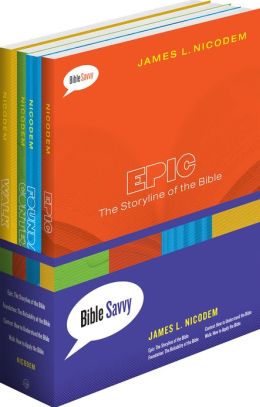
The Bible Savvy Series
is a four-book series written by James Nicodem, who is the senior pastor at
Christ Community Church of St. Charles, Illinois. The four-book series “covers four essential Bible-related topics…as
a comprehensive manual for understanding God’s Word and putting it into
practice.”[i]
It is a very easy read that many can learn from, especially those who are new
to reading the Bible. Nicodem sets forth some good ideas that can be
implemented by those desiring to get more out of the Bible. The title of the
four-books are Epic, Foundation, Context, Walk.
EPIC: The
Storyline of the Bible
Epic begins the four-book series
by proclaiming, “Epic is a comprehensive
but-concise presentation of the Bible’s grand storyline.”[ii]
Nicodem does a good job at covering the main theme of the Bible, which
is the redemption of sinful mankind from eternal separation from God. He goes
through why mankind has a need for redemption, with Adam and Eve eating the
fruit of the tree of the knowledge of good and evil and the consequences of
their sin. But then he totally misses one of the most important verses found in
the Bible:
“And I will put enmity
Between you and the woman, And between your seed and her seed; He shall bruise
you on the head, And you shall bruise him on the heel.” Genesis 3:15
(NASB95)
This is where we first see in the Bible the plan of
redemption beginning, in fact it was so important Eve thought that it was to be
fulfilled when she had Cain (Genesis 4:1) thinking that he would be the one who
the LORD prophesied to crush the head of Satan.
Yet Nicodem skips over this important verse and states “God’s preparation began two millennia
before Jesus came to planet Earth, when God chose a man named Abraham.”[iii]
Throughout the
rest of the Epic book, Nicodem completely glosses over the important aspects of
the plan of redemption much like the example given above.
FOUNDATION: The
Reliability of the Bible
Foundation is the next book in
the series. The premise of this book is to give the reader a foundation about “…how God authored the Bible; protected the
Bible from errors over centuries of transmission; reveals Himself and His will
to you through the Bible; and expects you to saturate your life with the
Bible.”[iv]
Most of this book has good facts
to have for an easy, concise reference for the reliability of the Bible. Nicodem
points out the many archaeological finds and manuscript evidences that prove
the trustworthiness of the Bible that we have today.
CONTEXT: How to
Understand the Bible
Context is the third book in the
series. Overall in this book he does a good job at distinguishing how to read
the Bible in context, such as explaining why it is important to know the
historical, literary, theological and immediate settings of each book in the
Bible.
One of the issues that I have
with this book is his advice when coming across a Bible word that has many definitions
and how to know which one is the correct definition in context. He says “But you don’t need to pay attention to
multiple definitions of a word that you are studying. Simply select the single
definition that fits its setting best.”[v]
Really? How about explaining that there are some very good Lexicons that will
help you in understanding what tense the verse or words are written in the
original languages, as well as the way that the word is used in the current
passage, so that you can get a better understanding of what the word is saying
in context? This is crucial to properly exegeting the Word of God in context. The
Bible was not originally written in English, and the text can then be easily misinterpreted
if you overlook this imperative truth.
WALK: How to
Apply the Bible
Walk is the fourth and final
book in the series. The theme of this book is putting everything that the
reader has learned in the first three books, and applying it to their daily
lives. One caution though, he seems to error on the side of Law, saying you
need to do this or that, instead of saying that our response to the grace of
God should be what spurs us on to reading and studying the Bible and being
doers of the Word.
He does give some good practical
tips on studying the Word, but again it seems littered more with legalism than
the response of God’s grace in our lives.
There are some major issues
throughout the four-book series in that he positively promotes emergent
authors/pastors such as Mark Driscoll, contemplative advocate John Ortberg, social
gospel proponents like Bill Hybels, Francis Chan, and Tim Keller, as well as
ecumenicalism proponent Charles Colson and Mormon Stephen Covey. He fails to
mention that a female pastor is not allowed in the Bible (2 Timothy 5:9-15). I
feel that he simplifies many of the topics in the Bible too much, almost to the
point of being disrespectful and making light of different topics. In a series
that is supposed to give the reader a good overview of the Bible, the author
spends too much time pushing his personal thoughts on eschatology, what version
of the Bible is the best, as well as the importance of tithing (though he fails
to mention that was Old Testament Law and never commanded of the New Testament
church).
The Bible Savvy Series only has
a few redeeming qualities, but I would not recommend anyone to spend the money
on this series and I give it one star out of five.


No comments:
Post a Comment