
Luke 02.08-20
Last time we looked at The Birth at Bethlehem and saw that the
events that Dr. Luke records for us in this section (Luke 02.01-20)
is probably the most detailed account of the birth of
Jesus found in the Gospels. We saw that Jesus
was born in Bethlehem. The word Bethlehem in Hebrew (H1035. Mxl tyb Beyth Lechem bayth leh’-khem) means “house of bread”,
an ideal birthplace for the Bread of Life (John 06.35) to be born!
Paul talks about Jesus coming as a
man “who,
although He existed in the form of God, did not regard equality with God a
thing to be grasped, but emptied Himself, taking the form of a bond-servant, and being made in the likeness of men.”
(Philippians
02.05-07) “For you know the grace of our Lord Jesus Christ, that
though He was rich, yet for your sake He became poor, so that you through His
poverty might become rich.” (2Corinthians 08.09) “By common confession, great is the mystery
of godliness: He who was revealed in the flesh, Was vindicated in the Spirit,
Seen by angels, Proclaimed among the nations, Believed on in the world, Taken
up in glory.” (1Timothy 03.16)
Jesus was God in flesh. He came to die and rise from the dead
for our sins so that mankind can now go to Heaven and have eternal life. He did
not come to reform the world, to fight for the underdog, to bring about social
justice to the oppressed. He didn’t come to be like Gandhi or Mother Teresa. He
didn’t come to reform society. Jesus is the “savior of the world” (John 04.42;
1John 04.14)
who has come “to
seek and to save that which was lost” (Luke 19.10) because His name is “Jesus, for He
will save His people from their sins.” (Matthew 01.21).
What we will see this morning in
The
Angelic Announcement…01. The
Audience (Luke 02.08); 02. The Announcement (Luke 02.09-13);
and 03. The Action (Luke 02.15-20).
01. The Audience (Luke 02.08)
Luke 02.08 “8 In the
same region” This is in reference to the Bethlehem region, where
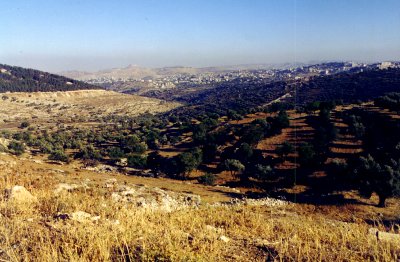
Joseph and Mary had to go to be registered for the census (Luke 02.01-05). Remember that this Bethlehem is about five miles South of Jerusalem, and its elevation is about
2,460 feet above sea level. There is another Bethlehem, also known as Bethlehem
of Zebulun or Bethlehem of Galilee (up by the Sea of Galilee), and referenced to
in Joshua 19.15.
Bethlehem of Zebulun was closer to where Mary was living in
Nazareth http://www.keyway.ca/gif/twobeth.gif.
The way that the prophecy in Micah 05.02 is written is the
LORD talking to this city as if it were a person, which was a common Jewish method.
Last time I briefly mentioned that
Bethlehem Ephrathah was
where Rachel, the wife of Jacob/Israel died in Genesis 35.19. But if we keep
reading in Genesis
35.20-21 we see something interesting about this location. http://www.rachelstomb.org/capsulehistory.html
Genesis
35.21 records that Israel went and pitched his tent beyond the “tower of Eder”,
which was about a mile from Bethlehem Ephrathah. The “tower of Eder” (Genesis 35.21)
in Hebrew is “Migdal Eder” and it means “Tower of the Flock”. This “Migdal
Eder” or “Tower of the Flock” was a watchtower built for the protection of the
flocks against robbers or animals or any thing that could cause any harm to the
flocks and is also mentioned in Micah 04.08. http://www.mayimhayim.org/Rabbi%20Mike/Graphics/Migdal%20Eder.jpg
According to Alfred Edersheim in his book The
Life And Times Of Jesus The Messiah, in Book 2, Chapter 6, “This Migdal Eder was
not the watchtower for the ordinary flocks which pastured on the barren
sheepground beyond Bethlehem, but lay close to the town, on the road to
Jerusalem. A passage in the Mishnah (Oral traditions written down) (Shekalim 07.04) leads to the
conclusion, that the flocks, which pastured there, were destined for
Temple-sacrifices, and, accordingly, that the shepherds, who watched over
them, were not ordinary shepherds…The same Mishnic passage also leads us to
infer, that these flocks lay out all year round, since they are spoken of as in
fields thirty days before the Passover-that is, in the month of February, which
in Palestine the average rainfall is the greatest…shepherds watched the flocks
destined for sacrificial services, in the very place consecrated by tradition
that where the Messiah was to be first revealed.”
What Edersheim is saying is that these shepherds were not
just your ordinary shepherds. They were priestly shepherds who were educated in
how the sheep had to be so that they would qualify for the strict restrictions
of the sacrificial system. It was their job to make sure that none of the
animals were hurt, damaged, or blemished so that they could meet the strict
demands of a sacrifice that would be approved by God (Exodus 12.05; Leviticus
22.20-25; Deuteronomy 15.21; Deuteronomy 17.01). It was said
that the priests would come here to the Migdal Eder to choose the two goats
that would be used for the sacrifice on Yom Kippur, the Day of Atonement.
On the ground floor of the Migdal Eder, there was a room was
designated for the delivery and protection of these special lambs after birth. After
the lamb was born, the shepherds would then wrap the newborn lambs in swaddling
cloths to protect the body of the lambs, so that later these same lambs could be
offered as sacrifices in the Temple, which was just about five miles away in
Jerusalem. Wrapping the newborn lambs in swaddling cloths was a way to
literally keep the new lambs “without spot or blemish” (Exodus 12.05; Leviticus
22.20-25; Deuteronomy 15.21; Deuteronomy 17.01) and the
shepherd would then lay the newborn lamb in a manger until they had calmed
down. This manger was kept ceremonially clean due to the fact that these lambs
would one day be a sacrifice in the Temple.
Comparing the sheep at Migdal Eder with Jesus:
-The sheep were born just outside of Bethlehem at Migdal
Eder, in the lower portion of the tower, wrapped in swaddling cloths and laid
in a manger. Jesus was born in Bethlehem, in the lower portion of the house,
wrapped in swaddling cloths and laid in a manger Luke 02.07.
-The sheep at Migdal Eder were later sacrificed in the
Temple in Jerusalem on Mt. Moriah, which is where Abraham was told to sacrifice
Isaac (Genesis 22.01-19), David
purchased the land from Ornan (1Chronicles
21.23-24), and where Solomon built the Temple (2Chronicles 03.01). John the Baptist declared
that Jesus was “…the
Lamb of God who takes away the sin of the world!” (John 01.29)
Jesus died on a cross in Jerusalem during Passover (Luke
22.07-20) “…with precious blood, as of a lamb unblemished and
spotless, the blood of Christ.” (1Peter 01.19)
to “…cleanse
your conscience from dead works to serve the living God” (Hebrews 09.14)
-The sheep at Migdal Eder were born so that they might die
to cover the sins of the people. Jesus was born so that He may die so that we
may live (John
10.11; 1Peter 02.24; 1Peter 03.18; 1John 03.05).
02. The Announcement
(Luke 02.09-14)
We are only 89 verses into this book and already Dr. Luke
records for us the third angelic visitation in Luke 02.09-14 (Zacharias in Luke 01.11 and Mary in Luke 01.28)! This angel unlike the other two occurrences
though is never identified, though many seem to think that this angel was
Gabriel as well.
Luke 02.09 “…and the glory of the Lord shone around them…”
We see the glory of the Lord, often described as a cloud throughout the Old
Testament (Exodus
16.07; Exodus 16.10; Exodus 40.34-35; 1Kings 08.11;
2Chronicles 07.01-03; Isaiah 06.03;
Isaiah 35.02;
Isaiah 40.05;
Isaiah 60.01;
Ezekiel
03.23). So possibly the glory of the Lord that was shining around
them was in the form of a cloud.
God’s glory had once dwelt in the Tabernacle (Exodus 40.34-35)
and in the Temple (2Chronicles 07.01-03). Ezekiel records
for us that the Shekinah (visible) glory of the LORD departed from the Temple because
of the sin of the nation (Ezekiel 08.04; Ezekiel 09.03; Ezekiel 10.04;
Ezekiel
10.18-19; Ezekiel 11.22-23).
Now the glory of God was returning to earth in the form of His
Son (John
01.14). That humble manger in a sense became the new Holy of Holies
because that is where the presence of God was in the form of Jesus the Baby! The
prophet Haggai said (by the inspiration of the Holy Spirit) that when the
Messiah (HaMashiach) comes He would make the Second Temple more glorious than
the First Temple (Haggai 02.09). This prophecy from Haggai was literally
fulfilled when Jesus was in the Temple (Matthew 12.06).
Luke 02.09 “…and they were terribly frightened.”
In the Greek “terribly
frightened” is (G3173 G5399) megav fobew megas phobeo (meg’-as fob-eh’-o) and translated from
Greek it is literally “…and they feared with fear great”
and this shows us the greatness and even the intensity of this moment.
All throughout the Bible we see recorded for us that
whenever an angel encountered a mortal man, that man or woman was filled with
great fear (i.e. Judges 13.22; Isaiah 06.04-05; Daniel 08.15-18; Daniel 10.07-09;
Daniel
10.16-17; Matthew 28.02-04; Luke 01.12; Luke 01.26-30). Those who
encountered an angel or the glory of God are instantly extremely aware of their
sinfulness (Job
42.05-06; Isaiah 06.05; Luke 05.08). So when you hear
about someone today claiming that they saw a vision of an angel or were in the
presence of God, see if their reaction was the same as Job, Isaiah, Peter and
the shepherds!
Luke 02.10 The shepherds were freaking out and the first words from
the angel were “Do not be afraid…” Just
like what Gabriel had said to both Zacharias and Mary (Luke 01.13;
Luke 01.30),
the angel here tells the shepherds that they have nothing to fear.
The shepherds did not need to fear the angel (Greek word
[G32] aggelov aggelos ang’-el-os
which means “messenger”) because the angel had a message not of judgment
but a proclamation of “good news” (Luke 02.10).
The phrase “good news” is the Greek word (G2097) euaggelizw euaggelizo (yoo-ang-ghel-id’-zo) and it means, “to announce good news” to “evangelize” and
“to preach the gospel”.
Luke 02.10 “of great joy which will be for all the people;”
this good news of great joy is for all mankind (Psalm 67.01-02; Psalm 98.02-03;
Isaiah 52.10;
Luke 24.45-46;
Colossians
01.23) because God sent His Son to be the Saviour of mankind!
Luke 02.11 The “city of David” is of course Bethlehem Ephrathah.
Luke 02.11 “there has been born for you a Savior,” Paul
tells us that the time of the birth of Jesus our Savior was in God’s perfect
timing (Galatians
04.04-05) to save all of mankind (2Timothy 01.09-10; Titus 02.10-14;
Titus
03.04-07; 1John 04.14).
What makes it so significant that a Saviour was born?
The need for a Saviour started when Adam and Eve sinned in the Garden of Eden (Genesis
03.01-07). Jesus was born as a man (Philippians 02.05-08) to fulfilled mankind’s greatest need, the need of a
Saviour. He was not born to rescue people from a bad marriage, or to get people
out of debt, or to get them rich, or to free them from some deep psychological
issue or to Make Every Day a Friday. He came to die to fulfill mankind’s true
problem, the problem we all have which is sin (Romans 03.10; Romans 03.23).
Because of the sin of Adam (Genesis 03.01-07), all of his descendants
including us today are all born in sin and separated from God (Romans 05.12).
No matter how you try to spin it, dress it up, decorate it or downplay it, sin
is rebellion against God (1John 03.04). For when God created Adam and
Eve, He gave them a perfect environment to live in, a utopian paradise if you
will. Adam and Eve had everything that they needed. God told them that they could eat of any tree in
the Garden of Eden except for one, the Tree of the Knowledge of Good and Evil (Genesis 02.17).
God told Adam that if he ate from that tree, he would “surely die” (Genesis 02.17).
The moment that Adam and Eve ate from the fruit of the Tree of the Knowledge of
Good and Evil (Genesis
03.06) was the moment that they rebelled against God, allowing for
sin and death to enter into the human race (Genesis 03.19; 1Corinthians
15.22) and plunging mankind into rebellion against God.
Because we are all descended from Adam, we are sinful from
conception (Psalms
51.05). Paul describes our sinful condition in Ephesians 02.03 and says in Romans 03.23
that “…all have sinned and fall short of the glory of God,” Because
of our sin, we needed a Saviour who could come and bridge the gap between God
and man. When Adam and Eve sinned, we have the first recorded
shedding of blood, the first sacrifice of the innocent for the guilty (Genesis 03.21).
From that point on, God required the sacrifice of an animal as a temporary sin
covering for His people. Every time that a man sinned and he then had to offer
an innocent animal to cover his sins, it was to be a reminder that sin is
costly, and to be a picture of the perfect sacrifice to come (Hebrews 10.01). For
many years, the Israelites sacrificed innocent lambs as a temporary covering of
their sin. But an animal substitute was not sufficient, because the
blood of animals cannot take away our sins but only temporally cover them (Hebrews 10.04).
The Law was foreshadowing Jesus. Read the Book of Leviticus, and the whole book
points to the work of Jesus and His substitutionary death for us (Hebrews 10.01). Offering the sacrifices of
innocent animals can never make us free from the guilt of sin. By offering sacrifices all it did was to
remind the Jews how sinful they were (Hebrews 10.02-04). If the blood of animals would have been good enough,
the writer of Hebrews tells us that they then would no longer have to offer
sacrifices. All that the sacrifices did was to cover their sins; it never took
away the guilty conscience that is within man. The writer of Hebrews refers often to
the Day of Atonement (Yom Kippur), which you can read about in greater detail
in Exodus
30.10, Leviticus 16.01-17.16
and Leviticus
23.16-32.
On the Day of Atonement, the High Priest would go into the
Holy of Holies to offer a sacrifice of atonement on behalf of the nation to
cover the sins of the nation from the previous year. The Hebrew word for
atonement is (H3722) rpk kaphar kaw-far’ meaning to cover, to cancel, to
purge away, to pardon and to make reconciliation. Hebrews 10.04 Tells us that the
blood of the animals just merely covered our sin. In order for our sins to be
completely forgiven and redeemed, we needed a kinsman redeemer (Leviticus
25.47-55; Ruth 03.01-04.13; Hebrews 02.11-18). The Hebrew
word for “kinsman” (H1350) is lag
ga’al gaw-al’; and it means to
redeem, to buy back a relative’s property. The Book of Ruth provides a great picture of this when Boaz “redeemed” Ruth
and Naomi (Ruth 03.01-04.13).
But of course an even greater example is that of
Jesus the Christ, our redeemer (Titus 02.14).
There are four requirements of a
Kinsman Redeemer:
01. The kinsman redeemer had to be a blood
relative Jesus fulfilled this requirement in His incarnation,
coming to be a man in flesh to show us our need for a Saviour (John 01.14;
Romans 01.03;
Romans 08.03;
Galatians
04.04; Philippians 02.06-08; Hebrews 02.14-17; Hebrews 04.15).
02. The kinsman redeemer could not be in debt
Jesus came as a man, but He was without sin (Isaiah 53.09;
2Corinthians
05.21; Hebrews 04.15; Hebrews 07.26; 1Peter 02.22;
1John 03.05)!
03. The kinsman redeemer had to be able to
pay the price of redemption The price of redemption was the
sinless man taking our place on the cross to appease the wrath of God (Matthew 27.54;
Mark 01.01;
Mark 03.11;
Mark 15.39;
Luke 01.35;
John 01.34;
John 01.49;
Acts 08.37;
1John 05.13).
04. The kinsman redeemer had to be willing
Jesus came as a man willing to pay the price for redemption. This is why He was
born, to purchase with His blood the redemption of mankind by His death (John 10.15-18;
Philippians
02.06-08; 1John 03.16).
The miraculous conception (Matthew 01.18-20; Luke 01.26-45)
and the Virgin Birth of Jesus Christ was a necessary sign proving His deity and
preexistence (Isaiah
07.14; Isaiah 09.06; Galatians 04.04; 1Timothy 03.16).
It is important that His name is “Immanuel”, because if He had not been
Immanuel (meaning God with us), He
could not have been Jesus the Saviour (Isaiah 07.14; Matthew 01.23)! The Jews at this
time all would know that a virgin giving birth was in fulfillment of Isaiah 07.14
and Jeremiah
31.22, and that it was a sign that the Messiah was now here! The
fact that the Messiah would be virgin born was a sign that He was the Son of
God, for a virgin giving birth is impossible unless it’s Divine!
On that night in Bethlehem, a son of Adam (Romans 05.14), the sinless and
spotless Lamb of God who was perfect and without sin was born to save mankind
from sin (John
01.29) and death, the punishment of sin (Romans 06.23). When He was
thirty-three years old, He willingly took our place on the cross and died for
us (Philippians
02.08). While He was dying on the cross, He said, “It is finished!”
(John 19.30)
or (tetelestai Tetelestai) which basically means, “The atonement has been accomplished, completely, once and for all
time.” Our salvation is all a work of God and not a work of man!
When He died, Mark tells us that “And the veil of the temple was torn in two
from top to bottom.” (Mark 15.38) This veil was 13-17 feet high, 6-8
inches thick, and it took 100 priests to move it! Three days later, He rose
from the dead, conquering sin and death (Acts 10.40; 1Corinthians 15.03-04; 1Corinthians
15.55-57), thus making it now possible for man to be reconciled to
God (Romans
05.08-11; 2Corinthians 05.18-19; Colossians 01.22; 1John 02.02).
So what was once only possible for one man to do once a year on the Day of
Atonement now has been made possible for all men who believe in Him (John 03.16-18;
Romans
10.09-13) and that is to approach God (Hebrews 04.16) personally
without the need of a priest.
Luke 02.11 “…who is
Christ (the anointed One) the Lord.” “Christ” is from a Greek word (G5547. Cristov Christos khris-tos’) that is a title which
means, “anointed one”. It is the same as “Messiah” or “Mashiach” in Hebrew. The
prophets would anoint the new king with oil, and Jesus is our anointed King of
Kings (Revelation
17.14; Revelation 19.16). “Lord” is also a title used for
someone who was in a position of authority. To call someone Lord was to
acknowledge your obedience and service. The angel of the Lord announced to the
shepherds that there was born for them a Saviour, who is Christ, the anointed
One, the Messiah (HaMashiach), the Lord!
Luke 02.12 The angel told the shepherds a sign of how they would recognize
this newborn Saviour, the Messiah, the Son of God, the Lord was. Most
Jewish mothers wrapped their babies in the strips of cloths, but most did not
lay down their baby in a manger. Once the shepherd’s heard the sign about
the baby, they would understand immediately what the sign meant, and they knew
to look for the Messiah (HaMashiach), the Lamb of God (John 01.29) in the manger in
Bethlehem. They also likely would have been familiar with the prophesy of Micah,
who foretold that the Messiah (HaMashiach) would be born in Bethlehem (Micah 05.02).
Luke 02.13-14 The
angels praised God at Creation (Job 38.07), and now they praised Him at the
birth of His Son. The whole purpose for the plan of salvation is bringing glory
to God (Ephesians
01.05-07; Ephesians 01.12; Ephesians 01.14). We
are not told exactly how many angels appeared praising God. But the Greek word
for “multitude”
is (G4128. plhyov) plethos play’-thos and it is used to signify “a
large number”.
Luke 02.13 “And on earth peace among men with whom He is
pleased.” This peace with God was prophesied in Isaiah 09.6-07; Micah 05.05;
Haggai 02.09;
Zechariah
06.12-13, and it only comes from being saved (Romans 05.01).
Luke 02.14 The Greek text here literally reads,
“men of His good pleasure.”
It was significant that the
angel revealed to the shepherds where the Messiah was born here at Migdal Eder.
Earlier we read Genesis
35.21, just after Jacob buried Rachel and we saw that he then went
to Migdal Eder, the tower of the flock. In the
Jewish Targums, which were Aramaic translations of the Hebrew Old Testament, Genesis 35.21 is translated as (Targum Yerushalmi) “And
Jakob proceeded and spread his tent beyond the tower of Eder, the place from
whence, it is to be, the King Meshiha (Messiah) will be revealed at the end of
the days”. http://juchre.org/targums/pgen.htm#gen35
Remember the last part of the quote from Alfred Edersheim’s book The Life And Times Of Jesus The Messiah, in Book 2, Chapter 6? “…shepherds watched the flocks destined for sacrificial services, in the very place consecrated by tradition that where the Messiah was to be first revealed.”
03. The Action (Luke 02.15-20)
It is interesting to think that
those who first heard the good news of the birth of the Saviour were shepherds.
Moses and David, two of Israel’s
greatest leaders were shepherds (Exodus 03.01; 1Samuel
16.11-13). Throughout the Old Testament,
God is often referred to as the “Shepherd of Israel” (Psalm 23.01; Psalm 80.01; Isaiah 40.11), and Jesus called Himself the “Good Shepherd” (John 10.11; John 10.14; Hebrews 13.20; 1Peter 02.25; 1Peter 05.04).
Luke 02.15 We
are not told how long the angels praised God, but when they left, they returned
to heaven where they resumed their praise and worship of God (Revelation
05.11-14). After which the shepherds wanted to get to Bethlehem as
quickly as possible to see their newborn Saviour.
Luke 02.16 Dr. Luke doesn’t tell us how they found their way, but when
they did, they found Him just as the angel had told them in Luke 02.12.
Luke 02.17 After seeing the newborn Saviour, and I’m sure that they
told Joseph and Mary all about their angelic experience, they went all over
telling everyone that Israel’s long-awaited Messiah had been born.
Luke 02.18 All who heard what the shepherds said were amazed at
what was being said.
Luke 02.19 Mary kept these things closely in her heart, knowing that
this was not a normal birth that was revealed by all the signs around the
birth. A mother forgets nothing of significance that happens to her
children. Everything that her children do or suffer, all that is said about
them, is treasured up in her mind; and often she thinks of those things, and
anxiously seeks what they may indicate respecting the future character and
welfare of her child.
Luke 02.20 After telling all what they had seen and heard, the
shepherds went back to their flocks, praising God. On this sacred night
there was born the “Sun of righteousness” bringing light into the
darkness of this world (Malachi 04.02).
We now
have come to the end of Dr. Luke’s narrative on the Birth of Jesus. You might
have noticed that there were no magi mentioned, and that is because they were
not present on the night of our Saviour’s birth



No comments:
Post a Comment